Retirement Field Notes:
Happy Retirement: Why the Greeting Card Isn’t the Whole Story
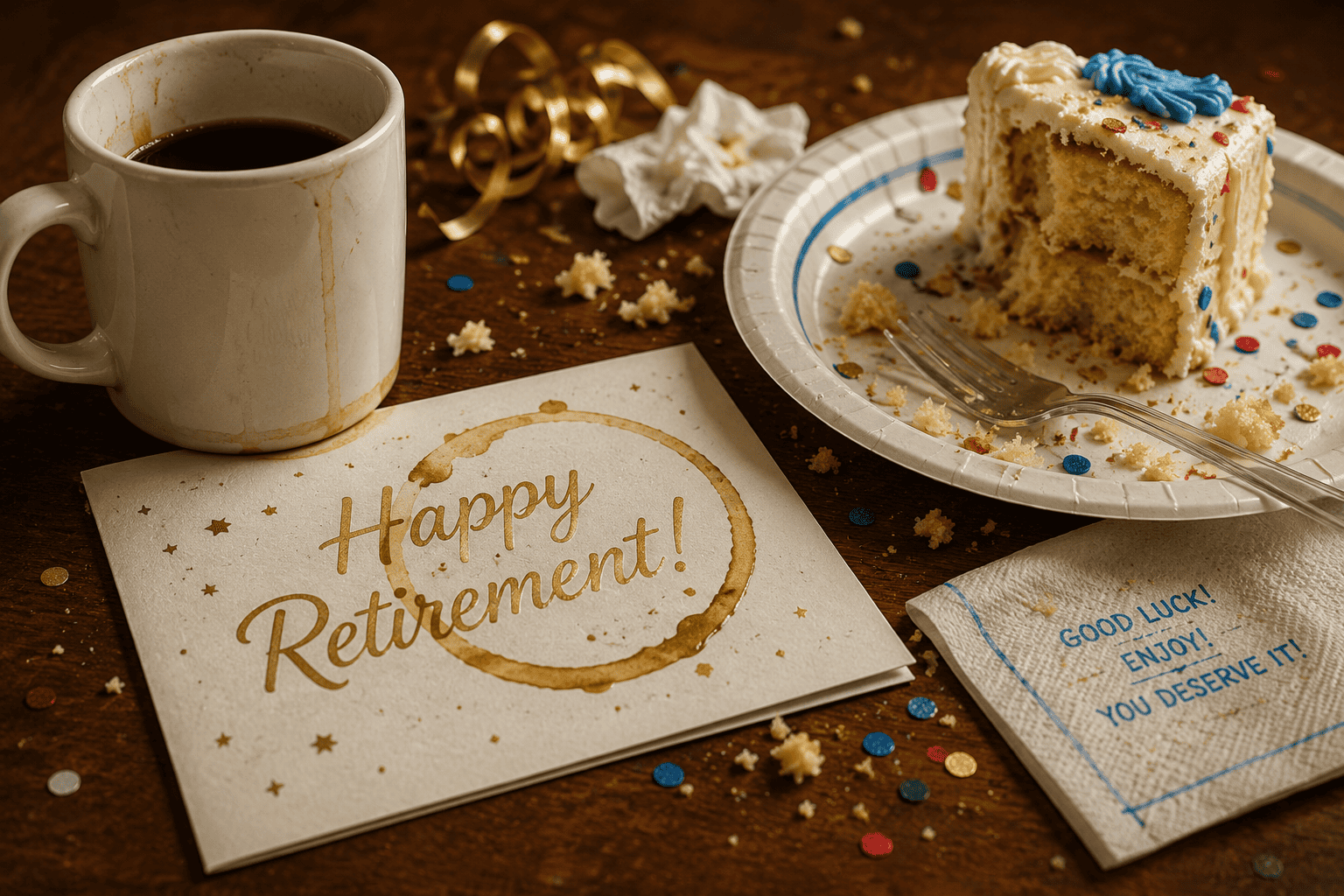
Retirement is one of the few major life transitions that comes with a cake.
There are speeches.
Cards.
Perhaps a watch.
Maybe a gift certificate.
Someone says a few nice words.
Everyone congratulates you.
Then you walk out the door.
The strange part is that the people planning the celebration are usually the ones who aren’t retiring.
The people who have just retired are often standing in the middle of it, wondering what exactly they’re supposed to be celebrating.
The end of work?
Certainly.
The freedom that follows?
Hopefully.
But beyond that, things become surprisingly vague.
For decades, retirement has been presented as a destination.
Work hard.
Save money.
Retire.
The story practically writes itself.
The retirement industry certainly thinks so.
The financial plan is complete.
The cheque clears.
The moving truck leaves.
The condo closes.
The golf clubs arrive.
Mission accomplished.
The assumption seems to be that retirement has now begun.
And yet six months later, many retirees find themselves sitting at the kitchen table, staring into a cup of coffee, wondering:
Has it started yet?
Not work.
That clearly ended.
Retirement…
The thing they spent decades planning for.
That thing everyone told them would be wonderful.
The thing that was supposed to arrive once work disappeared.
This question fascinated me because it doesn’t sound like unhappiness.
It doesn’t even sound like dissatisfaction.
It sounds more like anticipation mixed with uncertainty.
A feeling that something important is supposed to be happening, but hasn’t quite revealed itself yet.
At first glance, this seems odd.
After all, retirement is one of the most planned-for transitions in adult life.
People spend decades preparing financially.
Entire industries exist to help them get there.
But the more I observe retirees, the more I think we’ve confused preparing for retirement with preparing for life after work.
Those are not the same thing.
Work does more than provide income.
For decades, it quietly organizes much of adult life.
It tells us where to be.
What we’re working toward.
Who we’ll spend time with.
How our days are structured.
How progress is measured.
Who needs us?
Many of these things become so familiar that we stop noticing them.
I’ve written before about how many of us experience two retirements: the financial event that ends our career, and the psychological transition that follows. Understanding the difference helps explain why leaving work and feeling retired are often months—or even years—apart.
Until they disappear.
The surprising thing isn’t that retirees sometimes feel lost.
The surprising thing is that we expect them not to.
Because retirement is often treated as an ending.
A successful conclusion to a working life.
A reward.
A finish line.
What if that isn’t what retirement actually is?
What if retirement is better understood as a rite of passage?
A transition between one stage of adulthood and another.
Anthropologists have long observed that rites of passage tend to involve three phases. That uncertain middle has become one of the most interesting parts of retirement for me. It’s the place I’ve described elsewhere as The Lock—the stretch between what was and what comes next.
The old identity ends.
A period of uncertainty follows.
Eventually a new identity emerges.
Retirement contains all three.
The first phase receives enormous attention.
The last day of work.
The retirement party.
The farewell card.
The final meeting.
The second phase receives almost none.
The in-between period.
The awkward stretch where old structures have disappeared but new ones have not yet formed.
The period where people begin asking questions they never needed to ask before.
What matters now?
How do I want to spend my days?
Who am I when work is no longer part of the answer?
What comes next?
Perhaps this is why retirement can feel strangely unfinished.
Or perhaps unfinished is the wrong word.
Maybe what retirees are actually experiencing is the beginning of something that has not fully arrived.
A life stage that cannot be planned with the same precision as a pension.
A chapter that reveals itself gradually through experience.
The retirees who seem to navigate this period most successfully rarely have all the answers.
Instead, they remain curious.
They experiment.
They volunteer.
Travel.
Take classes.
Join clubs.
Learn new skills.
Become beginners again.
They treat retirement less like a destination and more like an exploration.
Not because they failed to plan.
Because some parts of life can only be discovered by living them.
This may be why so many retirees eventually find themselves searching for something they struggle to name.
Not happiness exactly.
Purpose?
Identity?
Something closer to a beginning.
A sense that the next chapter has finally started to take shape.
Which brings me back to the retirement party.
The cake.
The speeches.
Congratulations.
Perhaps we’ve been celebrating the wrong thing.
Or at least celebrating only half of it.
The retirement party marks the end of a career.
What it cannot celebrate is the life that follows.
Nobody knows what that life will look like yet.
Not even the retiree.
And perhaps that’s exactly why retirement can feel so strange.
Everyone else believes the story has ended.
The retiree is still waiting to discover how the next one begins.

Cynthia Ross Tustin is the founder of I'm Thinking of Retiring, an online publication exploring the psychology, purpose, and everyday realities of life after work. A retired Fire Chief, former ICU and Emergency Room nurse, instructor, and policy writer, she combines lived experience, research, and a lifelong curiosity about human behaviour to write thoughtful essays on retirement, identity, purpose, friendship, and the ordinary moments that quietly reveal something larger. Through her Retirement Field Notes and Ordinary Tuesday series, she encourages readers to approach this next chapter with curiosity rather than certainty.