Movement That Keeps You in the Game: The Best Low-Impact Activities for Adults Over 55
“Motion is lotion.”
If you are over 55, you have probably heard that phrase before.
And honestly?
There is probably more truth in it than most people realize.
My grandfather played golf regularly until he was 98 years old.
He and my grandmother also swam well into later life.
Looking back now, I do not think those activities simply helped keep them physically healthier.
I think they helped keep them engaged with life itself.
Because movement after retirement is rarely just about:
- exercise
- calories
- flexibility
- or fitness trackers
It becomes about:
- participation
- freedom
- independence
- confidence
- curiosity
- travel
- social connection
- and continuing to say yes to life
That matters enormously.
Especially after retirement.
The Goal Is Not Just Living Longer
One of the biggest mistakes people make about fitness after 55 is assuming the goal is simply:
👉 longevity.
But most people do not dream about:
- lower cholesterol
- improved VO2 max
- or slightly better blood pressure numbers (okay, maybe this one)
They dream about:
- walking through Rome without exhaustion
- climbing the stairs in Santorini
- snorkeling in Costa Rica
- hiking near Machu Picchu
- biking through vineyards in Tuscany
- playing golf with friends
- carrying their own luggage
- chasing grandchildren around the backyard
- or still feeling physically capable at 75, 85, or 95
That is a very different kind of motivation.
And honestly?
It is probably a healthier one.
The goal is not merely preservation.
It is:
👉 preservation through participation.
Why Low-Impact Activities Matter More After 55
As we age, the body changes.
Recovery slows.
Joints become less forgiving.
Muscle mass naturally declines.
Balance and flexibility can deteriorate if ignored.
But here is the important part:
👉 movement remains one of the strongest predictors of healthy aging.
Research consistently shows that regular physical activity supports:
- cardiovascular health
- mobility
- strength
- cognition
- mood
- balance
- stress reduction
- and independence later in life
Even low-intensity movement has been shown to improve:
- energy
- well-being
- physical function
- and quality of life in older adults.
Research also suggests that regular physical activity supports healthier aging by improving mobility, cognition, mood, and overall quality of life in older adults (Bherer et al., 2013; Taylor, 2014).
And importantly:
low-impact does NOT mean low-benefit.
It simply means reducing excessive stress on:
- joints
- connective tissue
- and recovery systems
while still preserving movement, strength, and participation.
Retirement Changes More Than Your Schedule
One of the things I think people underestimate about retirement is how much movement disappears naturally once work ends.
Careers often provide:
- routine
- walking
- stairs
- structure
- social interaction
- and momentum
Without realizing it, many retirees become dramatically less active almost overnight.
And when movement decreases:
- energy often drops
- confidence can decline
- stiffness increases
- social isolation becomes easier
- and participation slowly narrows
That is one reason low-impact activities matter so much after retirement.
They help restore:
👉 rhythm
👉 momentum
👉 and engagement with life itself.
Nature Changes the Experience Too
Movement outdoors appears to provide benefits that go far beyond physical fitness. Studies increasingly suggest that time spent moving in natural environments may help reduce stress, improve mood, support cognitive restoration, and enhance emotional well-being (Twohig-Bennett & Jones, 2018).
Research suggests time spent moving in nature may support:
- reduced stress
- improved mood
- cognitive restoration
- emotional well-being
- and mental health
And honestly?
Most people feel that intuitively already.
A treadmill in a basement does not feel the same as:
- walking a beach
- hiking through rainforest
- cycling along vineyards
- kayaking calm water
- or golfing with friends on a sunny morning
Nature changes the movement from:
❌ exercise
into:
✅ experience.
That distinction matters.
Low-Impact Does Not Mean Avoiding Challenge
This is important.
Low-impact does NOT mean:
- fragile
- sedentary
- inactive
- or avoiding effort entirely
In fact, some impact remains extremely important as we age — especially for post-menopausal women.
Weight-bearing movement helps support:
- bone density
- muscle preservation
- balance
- coordination
- and long-term mobility
Activities like:
- walking
- hiking
- resistance training
- stair climbing
- and light strength work
all play an important role in healthy aging.
The goal is not to eliminate challenge.
The goal is:
👉 sustainable movement you can continue doing for decades.
The Social Side of Movement Matters Too
Exercise after retirement is not just physical.
It is social. Social connection itself is strongly associated with healthier aging, lower mortality risk, improved mental health, and greater long-term well-being (Holt-Lunstad et al., 2010).
Work naturally provides:
- interaction
- accountability
- shared experiences
- and routine
Retirement quietly removes many of those things.
That is one reason activities done:
- with friends
- as a couple
- or within a group
often become easier to maintain.
People are far more likely to continue activities they genuinely enjoy.
And enjoyment matters.
Because behavioral science consistently shows that people sustain activities more successfully when they are connected to:
- pleasure
- identity
- meaning
- social reinforcement
- and future participation
rather than:
- guilt
- fear
- or obligation
1. Walking
Walking may be the single most underrated healthy-aging activity on the planet.
It supports:
- cardiovascular health
- mobility
- circulation
- balance
- bone strength
- and mental health
without requiring:
- expensive equipment
- gym memberships
- or perfect athletic ability
And perhaps most importantly:
walking keeps you participating in life.
It allows you to:
- explore cities
- travel independently
- wander markets
- hike trails
- and remain physically capable of everyday experiences
That matters.
2. Swimming and Water Fitness
Swimming is one of the best low-impact activities available after 55.
Water reduces stress on:
- hips
- knees
- joints
- and the spine
while still providing:
- cardiovascular conditioning
- flexibility
- resistance
- and full-body movement
And honestly?
Moving through warm water simply feels good.
Water fitness classes also create:
- social connection
- routine
- accountability
- and community
—all things that matter enormously during retirement transition.
3. E-Biking
E-bikes are one of the smartest innovations to happen to active aging in years.
They reduce just enough friction to make cycling accessible again.
Hills feel manageable.
Distances feel possible.
Exploration expands again.
And importantly:
e-biking allows many people to continue participating in activities they might otherwise slowly abandon.
That matters far more than cycling purists sometimes admit.
4. Strength Training
Strength training becomes MORE important with age, not less.
Why?
Because muscle loss accelerates over time.
Maintaining strength helps preserve:
- independence
- posture
- balance
- mobility
- bone density
- and confidence
And no…
you do not need to become a competitive bodybuilder.
Simple resistance work using:
- dumbbells
- resistance bands
- bodyweight exercises
- or machines
can dramatically improve long-term quality of life.
Especially for women after menopause.
5. Hiking
Hiking combines:
- movement
- balance
- cardiovascular activity
- nature exposure
- and exploration
all at once.
And unlike traditional workouts, hiking usually feels connected to:
👉 curiosity and experience.
Not punishment.
The goal is not conquering Everest.
The goal is to remain capable of adventure.
6. Kayaking and Paddle Sports
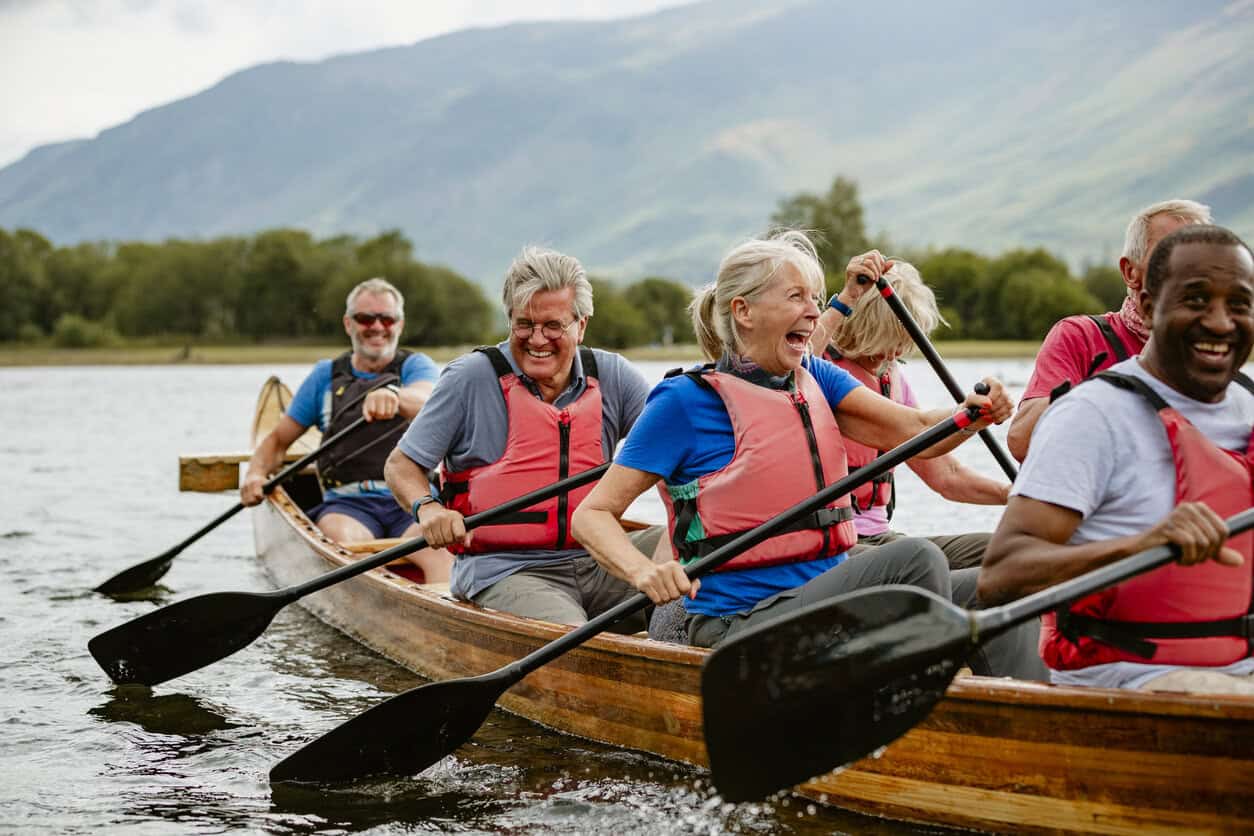
Kayaking is one of my favorite examples of movement disguised as enjoyment.
It combines:
- upper-body movement
- coordination
- balance
- mobility
- and nature exposure
without feeling repetitive or artificial.
And honestly?
Quietly paddling through calm water can feel deeply restorative in ways difficult to fully explain.
7. Gardening
Gardening may not look like exercise.
But physically?
It absolutely counts.
Gardening naturally encourages:
- bending
- carrying
- lifting
- squatting
- stretching
- and walking
while also supporting:
- stress reduction
- routine
- purpose
- and cognitive engagement
It also reconnects people to:
- seasons
- sunlight
- growth
- and rhythm
—which retirement sometimes quietly disrupts.
8. Dancing
Dancing may be one of the best healthy-aging activities nobody talks about enough.
It combines:
- movement
- balance
- coordination
- memory
- rhythm
- and social interaction
all at the same time.
And importantly:
people tend to continue activities that feel joyful.
Whether it is:
- ballroom dancing
- salsa
- line dancing
- or music at a beachside restaurant in Costa Rica
movement still counts.
Fitness Is Really About Capability
One of the biggest shifts that happens after 55 is that fitness stops being primarily about appearance.
It becomes about:
- capability
- freedom
- confidence
- participation
- and independence
The goal is not becoming twenty-five again.
The goal is remaining capable of:
- travel
- adventure
- movement
- curiosity
- connection
- and participation in your own life
for as long as possible.
That is a much more meaningful goal.
Final Thoughts About Low-Impact Activities for Adults Over 55
Healthy aging does not require punishment.
It does not require:
- extreme workouts
- marathon training
- or pretending your body still recovers as it did at 30
What it does require is:
👉 movement
👉 consistency
👉 curiosity
👉 recovery
👉 social connection
👉 and activities meaningful enough that you actually want to keep doing them
Because the best exercise after 55 is usually not:
👉 the hardest one
It is:
👉 the one that keeps you in the game.
Related Reading
E-Biking for Active Retirees: Freedom, Fitness, and Confidence on Two Wheels
Snorkeling in Costa Rica: Why It’s Perfect for Active Retirees
Retirement Transition: The Science Behind Why It Feels Harder Than Expected
12 Healthy Habits for Retirees That Make Retirement Smoother
Is Retirement Like Quitting Sugar?
This article is informed by research in healthy aging, movement, behavior change, social connection, and retirement wellness, including:
References
- Bherer, L., Erickson, K. I., & Liu-Ambrose, T. (2013). A review of the effects of physical activity and exercise on cognitive and brain functions in older adults. Journal of Aging Research.
https://www.ncbi.nlm.nih.gov/pmc/articles/PMC3872757/ - Holt-Lunstad, J., Smith, T. B., & Layton, J. B. (2010). Social relationships and mortality risk: A meta-analytic review. PLoS Medicine.
https://journals.plos.org/plosmedicine/article?id=10.1371/journal.pmed.1000316 - Taylor, D. (2014). Physical activity is medicine for older adults. Postgraduate Medical Journal.
https://pmc.ncbi.nlm.nih.gov/articles/PMC4241367/ - Twohig-Bennett, C., & Jones, A. (2018). The health benefits of the great outdoors: A systematic review and meta-analysis of greenspace exposure. Environmental Research.
https://pubmed.ncbi.nlm.nih.gov/29884547/

Cynthia Ross Tustin is the founder of I'm Thinking of Retiring, an online publication exploring the psychology, purpose, and everyday realities of life after work. A retired Fire Chief, former ICU and Emergency Room nurse, instructor, and policy writer, she combines lived experience, research, and a lifelong curiosity about human behaviour to write thoughtful essays on retirement, identity, purpose, friendship, and the ordinary moments that quietly reveal something larger. Through her Retirement Field Notes and Ordinary Tuesday series, she encourages readers to approach this next chapter with curiosity rather than certainty.