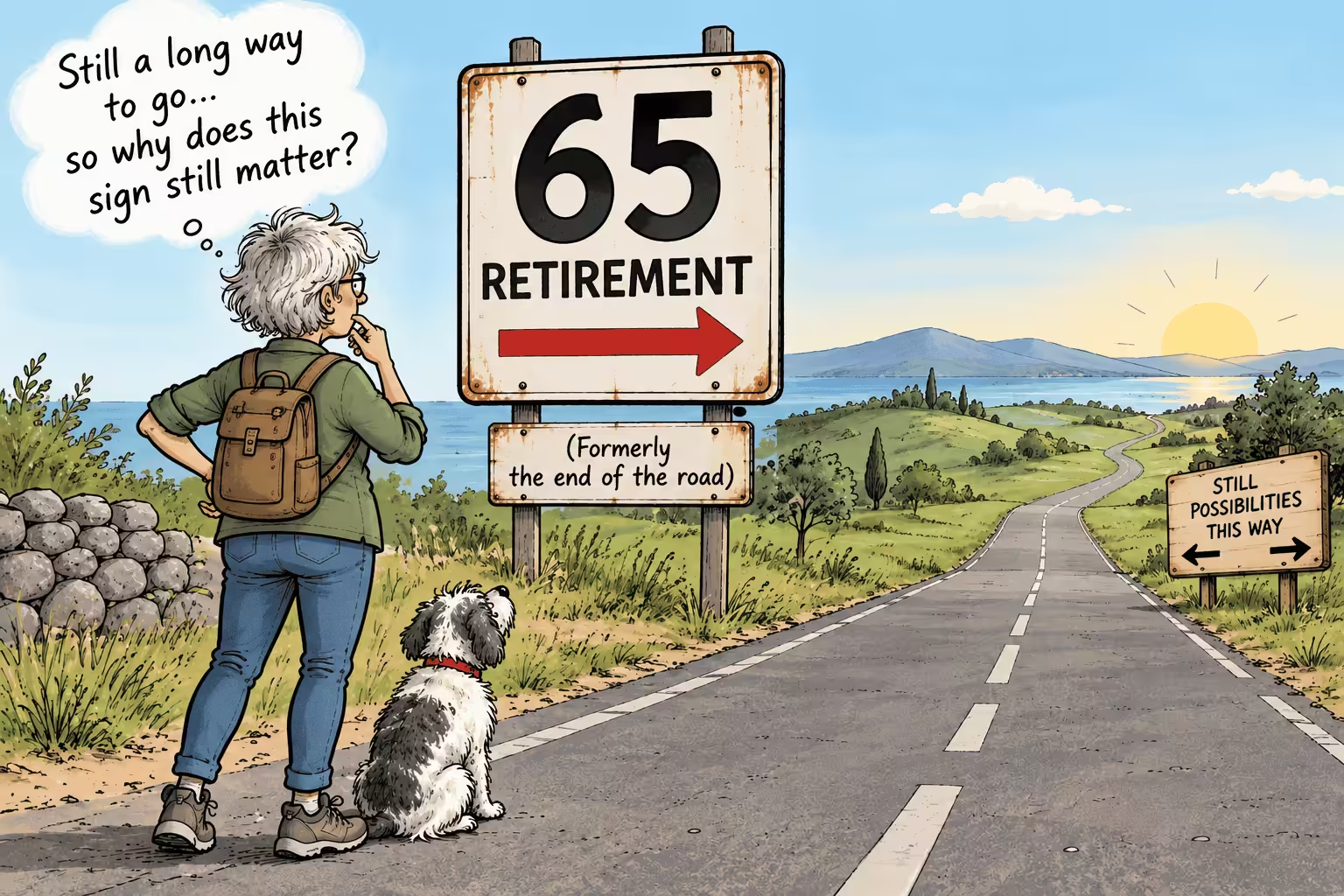
Mandatory Retirement Is Gone. So Why Are We Still Obsessed With 65?
I grew up in an analog world.
I learned how to read maps, use card catalogues, balance cheque books, develop film, and repair things myself. We knocked on doors instead of sending texts. If we wanted information, we went looking for it.
Then my generation helped build the digital world.
We adopted computers, learned email, embraced the internet, and carried smartphones into our workplaces. Many of us spent decades helping create the optimized systems that now shape modern life.
That leaves those of us who lived through the transition with something useful: comparative perspective.
We remember both worlds.
And lately I’ve been thinking that technology isn’t the only place where that matters.
Some of us also spent our careers living through two very different ideas about retirement.
When 65 Was the Answer
When I started my career in Ontario, retirement at 65 wasn’t merely a cultural suggestion.
Mandatory retirement was part of the employment landscape.
Technically, no Ontario law required everyone to retire at 65. Instead, Ontario’s Human Rights Code protected workers from age discrimination only until age 65, which allowed employers to have mandatory retirement policies.
There were exceptions, of course. Not every employer had one.
And people could retire before 65. Plenty did.
We even had a name for that.
Early retirement.
But 65 was widely understood as the normative endpoint of working life.
You could choose to leave before it.
What you couldn’t necessarily choose was to stay beyond it.
Then the rules changed.
Ontario ended mandatory retirement in 2006 by extending age-discrimination protection beyond 65. Generally speaking, your employer could no longer end your employment simply because you had reached your 65th birthday.
That gave workers a new kind of freedom.
Not the freedom to retire whenever they wanted. People who could afford to leave earlier had already been doing that.
It was the freedom to stay.
And that’s where things get interesting.
Because the rule changed.
Sixty-five didn’t.
Early Compared to What?
Think about the phrase early retirement.
If somebody tells you, “John retired early at 58,” nobody responds:
Early?
What do you mean by early?
Early compared to what?
We know.
He retired before 65.
Which is strange when you think about it.
If mandatory retirement at 65 is gone, what exactly makes 58 early?
Apparently the old measuring stick survived.
Sixty-five stopped being a compulsory endpoint for many workers, but it remained a normative one.
And perhaps that’s one reason the transition is so easy to overlook.
We changed the rule without entirely changing our idea of when a working life is supposed to end.
Some of Us Worked in Both Worlds
This isn’t exclusively a Gen X story.
Late Boomers and older members of Gen X, in particular, spent substantial parts of their careers in the old system before working through the transition to the new one.
I did.
My own career looked something like this:
Started career: endpoint largely supplied.
Mid-career: rules changing.
Late career: staying beyond the old endpoint increasingly became my decision.
Retirement planning culture: still waving vigorously at 65.
I began working in a world where there was a widely understood answer to the question:
When does a working life end?
By the end of my career, the answer was much less clear.
You don’t necessarily have to leave at 65 anymore.
Great.
So when should you leave?
Well, that’s up to you.
Well, shit!
Because that’s not actually an answer.
That’s permission to come up with one yourself.
We Gained the Freedom to Stay
I’m certainly not arguing that we should bring back mandatory retirement.
People differ.
Jobs differ.
Health differs.
Finances differ.
Families differ.
What people want from work differs.
Why on earth would one birthday provide the right answer for everyone?
Removing the mandatory endpoint expanded individual choice.
But it also did something else.
We gained the freedom to stay without acquiring a new way to decide when to leave.
That’s a very different problem.
Under the old system, you might have had to decide whether to leave early.
Under the new one, if you’re healthy, financially secure, capable of doing your job, and still enjoying it, you may have to decide when you’ve finally had enough.
Sixty-five?
Sixty-seven?
Seventy?
Why?
Why this year rather than next year?
What are you leaving for?
What are you staying for?
At what point are you finished?
Mandatory retirement supplied an answer to at least one of those questions.
Greater freedom removed it.
The Norm Outlived the Rule
There’s actually a concept in social science that may help explain some of this: structural lag.
Very simply, different parts of society don’t necessarily change at the same speed.
One institution changes while expectations, language, policies, or other institutions built around the old arrangement take longer to catch up.
And retirement certainly looks a bit like that.
Mandatory retirement largely disappeared.
But 65 remained deeply embedded in the retirement landscape.
It’s still the standard age associated with the Canada Pension Plan.
It’s when Old Age Security normally becomes available.
Pension plans still use concepts such as normal retirement age.
Retirement calculators and planning conversations routinely organize themselves around it.
And our language still recognizes it.
Early retirement.
The legal constraint weakened.
The normative reference point survived.
Maybe that’s why 65 can still feel like an answer even when nobody is standing at the office door insisting we leave.
Meanwhile, Apparently 55 Is the New 65
Then our cultural signals get even stranger.
I’m fond of saying 60 is the new 40.
Apparently, I was wrong.
55 is the new 65.
Because now we have 55+ Adult Living.
Adult living?
What the hell was I doing at 54?
We have active-adult communities.
Adult-lifestyle communities.
55+ living.
We’re not old. God forbid.
We’re just adults with a minimum age requirement.
I’m not suggesting that 55+ housing developed because mandatory retirement disappeared. I haven’t found evidence for that, and they appear to be separate developments.
It’s the coexistence that interests me.
On one hand, we’re increasingly told that the traditional retirement age matters less. People are living and working longer. Some continue in their careers, work part-time, consult, start businesses or move into entirely different kinds of work.
On the other hand, the housing market is perfectly happy to start selling us an age-defined post-work lifestyle at 55.
Meanwhile, we still understand exactly what someone means when they say they retired early at 58.
So what age is retirement now?
Fifty-five?
Sixty?
Sixty-five?
Seventy?
Maybe the problem isn’t that we haven’t figured out the new retirement age.
Maybe there isn’t going to be one.
The Rule Changed. The Decision Became Ours.
Perhaps that’s the more interesting legacy of mandatory retirement.
We tend to describe its disappearance entirely as an expansion of freedom.
And it was.
But freedom has another side.
When somebody else stops deciding for you, the decision doesn’t disappear.
It becomes yours.
For those of us whose careers crossed both worlds, that transition is particularly visible.
We remember when 65 was more than a number in a retirement calculator.
It was the normative endpoint.
Then the rule changed.
The endpoint became negotiable.
But the old reference point remained—in our pension systems, our planning, our expectations, and even in the word early.
We gained something valuable when mandatory retirement disappeared.
We gained the freedom to stay.
But we also inherited a question the old system largely answered for us:
If nobody is going to tell me when I’m done, how do I decide for myself?
Sixty-five still has an answer ready.
I’m just not sure it’s ours.
Related Reading
If you enjoy following ordinary observations that turn into bigger questions, you might also like:
- I Finally Have My Work-Life Balance: Why Should I Retire Now!
If nobody is making you leave, what happens when you finally have the freedom to stay—and discover you actually like your working life? - To Telic or Not to Telic: Why Retirement Feels Psychologically Strange
If 65 has spent decades looking like the finish line, this explores what happens when reaching the goal doesn’t automatically tell you what comes next. - The Pygmalion Effect and the New Reality of Retirement Expectations
Retirement changes more than where you spend your day. This explores what can happen when the expectations that surrounded your working life suddenly disappear.
Research Note
The observations in this article are informed by ongoing reading and research in psychology, sociology, adult development, aging, friendship, purpose, identity, and life transitions. While these essays are observational rather than academic, many of the underlying ideas are grounded in established research.
- McKinney v. University of Guelph
- The End of Mandatory Retirement: Ontario Human Rights Commission —
- Age Integration and the Lives of Older People: Matilda White Riley & John W. Riley Jr.
- Age Norms, Age Constraints, and Adult Socialization: Nuegarten, Moore & Lowe.

Cynthia Ross Tustin is the founder of I'm Thinking of Retiring, an online publication exploring the psychology, purpose, and everyday realities of life after work. A retired Fire Chief, former ICU and Emergency Room nurse, instructor, and policy writer, she combines lived experience, research, and a lifelong curiosity about human behaviour to write thoughtful essays on retirement, identity, purpose, friendship, and the ordinary moments that quietly reveal something larger. Through her Retirement Field Notes and Ordinary Tuesday series, she encourages readers to approach this next chapter with curiosity rather than certainty.