How to Build a Happy Life… Are You Sure That’s What You Really Mean?
Retirement Field Notes
An ongoing series of observations about life after work, identity, friendship, purpose, freedom, place, and the ways people continue to grow long after their careers end.
The usual retirement script is simple.
Work hard.
Save money.
Retire.
Be happy.
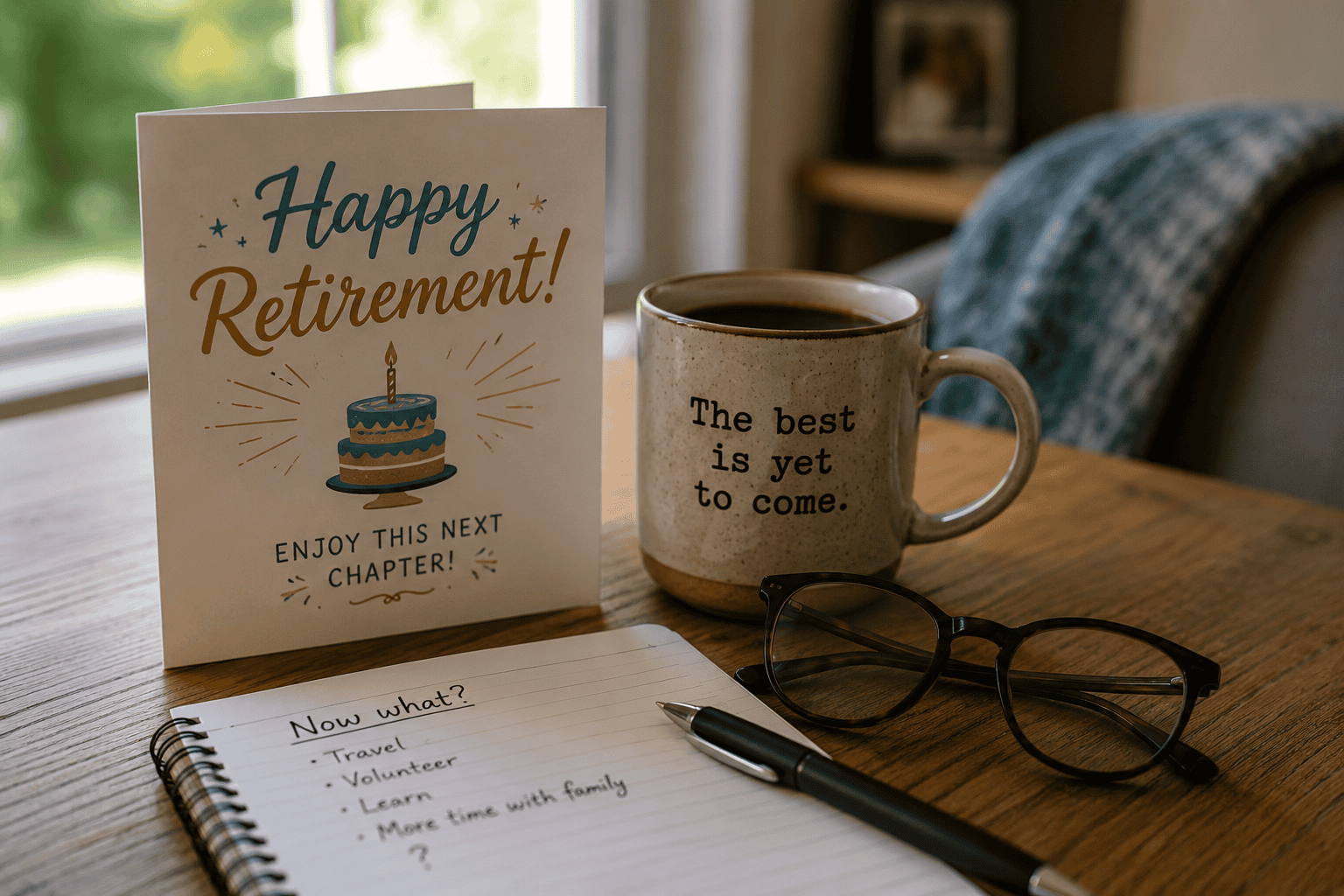
It even says so on the Hallmark cards sitting beside the retirement cake on your last day of work.
Your colleagues write it in farewell messages.
Your friends say it at retirement parties.
“Congratulations.”
“Enjoy your retirement.”
“Be happy.”
It’s a perfectly reasonable thing to wish for someone.
The longer I’ve been retired, however, the more I’ve wondered if happiness is really what most people mean.
A few months ago, I wrote an article about building a meaningful life after retirement. It explored the importance of purpose, relationships, challenge, growth, and contribution. The article was an attempt to understand why some retirees thrive while others struggle, even when they have enough money, good health, and all the freedom they once imagined.
I still agree with everything I wrote.
But the article left me with a different question.
When retirees say they want to be happy, what exactly do they mean?
The more I listen to people talk about retirement, the less certain I am that happiness is the right word.
Or perhaps it’s a convenient word.
A placeholder.
A socially acceptable shorthand for something much larger and more complicated.
After all, happiness isn’t the only word we use this way.
The Placeholder
When someone loses a spouse, a parent, or a child, we say:e
“I’m sorry for your loss.”
No one believes those four words adequately capture grief.
They are not meant to.
They are simply the best shorthand we have for something too large to fit into a sentence.
The phrase stands in for all the things we cannot adequately express.
Love.
Memory.
Absence.
Shock.
Helplessness.
Compassion.
We say the words because language runs out before the emotion does.
Perhaps happiness works the same way.
Retirement may have its own version of “sorry for your loss.”
It sounds like this:
“Be happy.”
What else are people supposed to write on the card?
Imagine the alternative.
I hope you discover who you are when nobody needs you at 8:00 a.m.
I hope you learn how to direct your own days.
I hope you find meaningful challenges.
I hope you build new friendships.
I hope you continue growing.
I hope you discover what matters now.
Those sentiments may be closer to the truth, but they don’t fit neatly on the front of a greeting card.
They May Be Wishing You a Happy Life
So instead, we say:
“Be happy.”
And everyone nods.
The interesting thing is that when people describe their retirement dreams, they rarely describe happiness itself.
They describe freedom.
They want to wake up without an alarm clock. (I wanted to never be woken up again at 3 am in January by my pager, for someone else’s emergency.)
They want control over their schedule. (I wanted to be in Costa Rica for the winter).
They want to travel.
Spend more time with family.
Volunteer.
Take classes.
Learn photography. (I wanted art classes)
Work in the garden. (Me too).
Read books.
Go for long walks.
Nobody says:
“I want more happiness.”
They describe a life with more choice.
More autonomy.
More control over how their time and attention are spent.
What they are often describing is freedom.
And freedom is wonderful.
But freedom and happiness are not necessarily the same thing.
This may explain why retirement can sometimes feel confusing.
For decades, work answered a remarkable number of questions automatically.
Where should I be?
Who needs me?
What am I working toward?
Who are my people?
How should I spend my day?
Retirement removes many of those answers.
That is exactly what most people want.
The surprise is what comes next.
Freedom creates space.
It does not automatically tell us what belongs in that space.
Eventually, a new question emerges.
Now what?
Now what? That question rarely appears on retirement cards.
Yet it may be one of the most important questions retirement asks.
The traditional script assumes that happiness naturally follows freedom.
Remove the obligations, and happiness appears.
Sometimes it does.
Sometimes it doesn’t.
Or perhaps more accurately, happiness turns out to be an incomplete description of what people are seeking.
Because after a while, most retirees start looking for something else.
Something interesting.
Something meaningful.
Something challenging.
Something worth getting out of bed for.
Something that connects them to other people.
Something that allows them to keep learning, contributing, growing, or creating.
The language changes.
Without realizing it, people stop talking about happiness and start talking about meaning.
Or purpose.
Or belonging.
Or curiosity.
Or contribution.
The word happiness was never wrong.
It was simply carrying too much weight.
Like a suitcase packed with things that should have been sorted into separate bags.
Inside that one word, we often find:
Freedom.
Autonomy.
Connection.
Purpose.
Growth.
Challenge.
Peace.
Belonging.
Security.
Love.
Contribution.
Curiosity.
No wonder it becomes difficult to define.
No wonder Google struggles to figure out what people mean when they search for a happy life.
I’m not sure people know what they mean.
I certainly wasn’t sure.
What I have come to believe is this:
Retirement is not a magic transformation.
It does not automatically create happiness any more than a gym membership automatically creates fitness.
It creates an opportunity.
The freedom to direct your own life.
The freedom to decide what matters.
The freedom to choose what comes next.
Perhaps that’s why so many retirees eventually discover that happiness was never really the destination.
It was the shorthand.
A useful word.
A convenient word.
A Hallmark word.
But underneath it sits a much larger collection of hopes, desires, fears, and aspirations that are far more difficult to describe.
The retirement card says:
Work hard.
Save money.
Retire.
Be happy.
Having lived in retirement for a while, I think a more honest version might be this:
Work hard.
Save money.
Retire.
Then figure out what you actually mean by happy.
Read More
- How To Build a Meaningful Life After Retirement
- To Telic or Not to Telic: Why Retirement Feels Psychologically Strange
- Retirement Timing, Longevity, and the Modern Midlife Crisis
- The Retirement Paradox
Research Note
The observations in this article are informed by ongoing reading and research in psychology, sociology, adult development, aging, friendship, purpose, identity, and life transitions. While these essays are observational rather than academic, many of the underlying ideas are grounded in established research.
- Ryan, R. M., & Deci, E. L. (2000).
Self-Determination Theory and the Facilitation of Intrinsic Motivation, Social Development, and Well-Being.
https://pubmed.ncbi.nlm.nih.gov/11392867/ - Ryff, C. D. (1989).
Happiness Is Everything, or Is It? Explorations on the Meaning of Psychological Well-Being.
https://pubmed.ncbi.nlm.nih.gov/2604993/ - Keyes, C. L. M. (2002).
The Mental Health Continuum: From Languishing to Flourishing in Life.
https://pubmed.ncbi.nlm.nih.gov/12090492/ - Steger, M. F. (2012).
Making Meaning in Life.
https://www.tandfonline.com/doi/full/10.1080/1047840X.2012.720832 - Setiya, K. (2017).
Midlife: A Philosophical Guide. Princeton University Press.
https://press.princeton.edu/books/hardcover/9780691173931/midlife

Cynthia Ross Tustin is the founder of I'm Thinking of Retiring, an online publication exploring the psychology, purpose, and everyday realities of life after work. A retired Fire Chief, former ICU and Emergency Room nurse, instructor, and policy writer, she combines lived experience, research, and a lifelong curiosity about human behaviour to write thoughtful essays on retirement, identity, purpose, friendship, and the ordinary moments that quietly reveal something larger. Through her Retirement Field Notes and Ordinary Tuesday series, she encourages readers to approach this next chapter with curiosity rather than certainty.