Ordinary Tuesdays
Observations from everyday life. The small moments, familiar places, chance conversations, and ordinary experiences that quietly reveal something larger.
Finding Your Tribe: How My Retired Mom Made New Friends and Why Cheese Dip Helped
A chance encounter with an old high school friend got me thinking about my parents’ retirement move, their earlier move to the boonies, and, of all things, cheese dip.
Briefly, I ran into an old classmate from Erin District High School and his wife at the grocery store. It was a complete surprise to see him there. Even more surprising, neither of us had aged a day!
He introduced me to his wife, and chitchat ensued. He told me that they had recently moved into Sandy Cove Acres. That’s a retirement community here in Simcoe County. Of course, my ears perked up because my grandparents moved in there in 1970. They were literally the fortieth couple to move in. Then my parents moved to Sandy Cove some forty years later. Ostensibly, to look after my grandparents (Granny and Pappy were in their late 90s and still living a great life in their own home).
My grandmother ran around bragging, “Our kids are moving in!”
But back to my friend and his wife.
The gist of the story that triggered that thought about my own parents’ relocation to Sandy Cove was this: she said she didn’t like it at all. And he said that he absolutely loved it there. She said she preferred her old neighbourhood, and he found new golf buddies the first week.
Youza. That summed up my parents in a flash! De ja freakin’ vu!
So let me tell you an insider family story.
The move to Sandy Cove was only the second time that my parents ever moved. The first one was in 1973, when we moved from the burbs of Mississauga to the boonies of Erin Township.
It was the house and property of my dad’s dreams! He didn’t care if he had to drive 90 minutes to work. He was ecstatic at his good fortune. My mother hated the property and the house and resented the move.
We didn’t even live in Erin proper. We lived out in the country. Driving us to elementary school was a twenty-minute ordeal on back roads. There were no immediate neighbours to wander over and visit.
Dad went to work. We went to school. Mom stayed home.
Mom was friendly. She was easygoing once she got to know you. She maintained friendships just fine.
But she wasn’t likely to make the first move. One of the only reasons my mom met any of our closest neighbours was because it just seemed normal to me to hop on my bike, pedal to the nearest house, knock on the door, and ask if their kids wanted to come out and play. She got to know those parents; we had a pool, and their kids often ended up at our house!
Perhaps that’s just a habit from me growing up feral. It was not a habit my mom, Carole, had.
Erin was a small town, full of well-established groups, clubs, and social organizations. It was also full of lifelong residents, third- and fourth-generation farmers, and small-town politics.
Those things were all absolutely true. However, my mom seemed to have predetermined that it was going to be “clique-y” long before she ever really tried. I loved her dearly, but she could take considerable pleasure in her own martyrdom. Her steadfast belief that everyone in Erin held even a moderate resistance to all newcomers suited her narrative.
There Were Doors
It’s tempting, looking backward, to say that the rural community wasn’t welcoming; chunks of it were.
Some of it wasn’t.
The other mothers in the PTA weren’t particularly warm to her. Some of the established local afternoon tea and card groups, fall fair boards, and horticultural groups weren’t exactly standing at the end of the driveway waving banners that said, Welcome, Carole!
But that isn’t the whole story.
There were plenty of doors.
There were euchre games and curling. Organizations looking for new volunteers. Drivers were desperately needed to take cancer patients to appointments.
I joined 4-H.
My mother wouldn’t volunteer to teach anything.
I took gymnastics.
She dropped me off and picked me up.
If she’d been churchy, perhaps she could have walked into a church. That’s one of the remarkable things about some affiliations: they’re portable. If you’re Catholic and you move, you can find the other Catholics without much effort or discomfort.
If you play hockey, you can find a league that fits your ability.
If your kid plays hockey, you don’t even have to play. Just sit in the bleachers long enough with the same group of freezing, bored parents, and eventually you’ll know somebody.
There were opportunities available to my mother.
She just wasn’t particularly inclined to look for them or walk into them.
And for about five years, she was lonely.
Eventually, she found herself a wedge.
A few mellow local women had room in their bowling group. Mom found some friends.
And then she got herself a job.
An hour away.
Back in Mississauga.
Her own friendship factory.
My dad eventually retired.
My mother kept working.
She still hated that house.
Then They Moved Again
Dad had always been adamant that he was never leaving Erin. He loved that house. He loved the property. He loved the life he’d built there.
Then Dad’s parents started to decline. And by decline, I mean they were 100 and 96, still living in their Sandy Cove Shangri-La, but couldn’t drive themselves to Florida anymore. Snowbirds with clipped wings.
So that was enough to convince my Dad that they should move there to be closer to them.
Mom was psyched. My dad was kinda meh about it.
More importantly, it got her out of Erin.
And damned if my mother didn’t love Sandy Cove.
My father tolerated it, mostly with a smile.
It was an almost perfect reversal of their last move.
So they moved.
Same two people in the same marriage. Different place. Completely different experience.
And meeting my old school chum and his wife, in the same predicament, reminded me just how lonely my mother had been after my parents’ first move and how much happier she was after the second one.
Now can you feel the de ja vu?!
What made the difference?
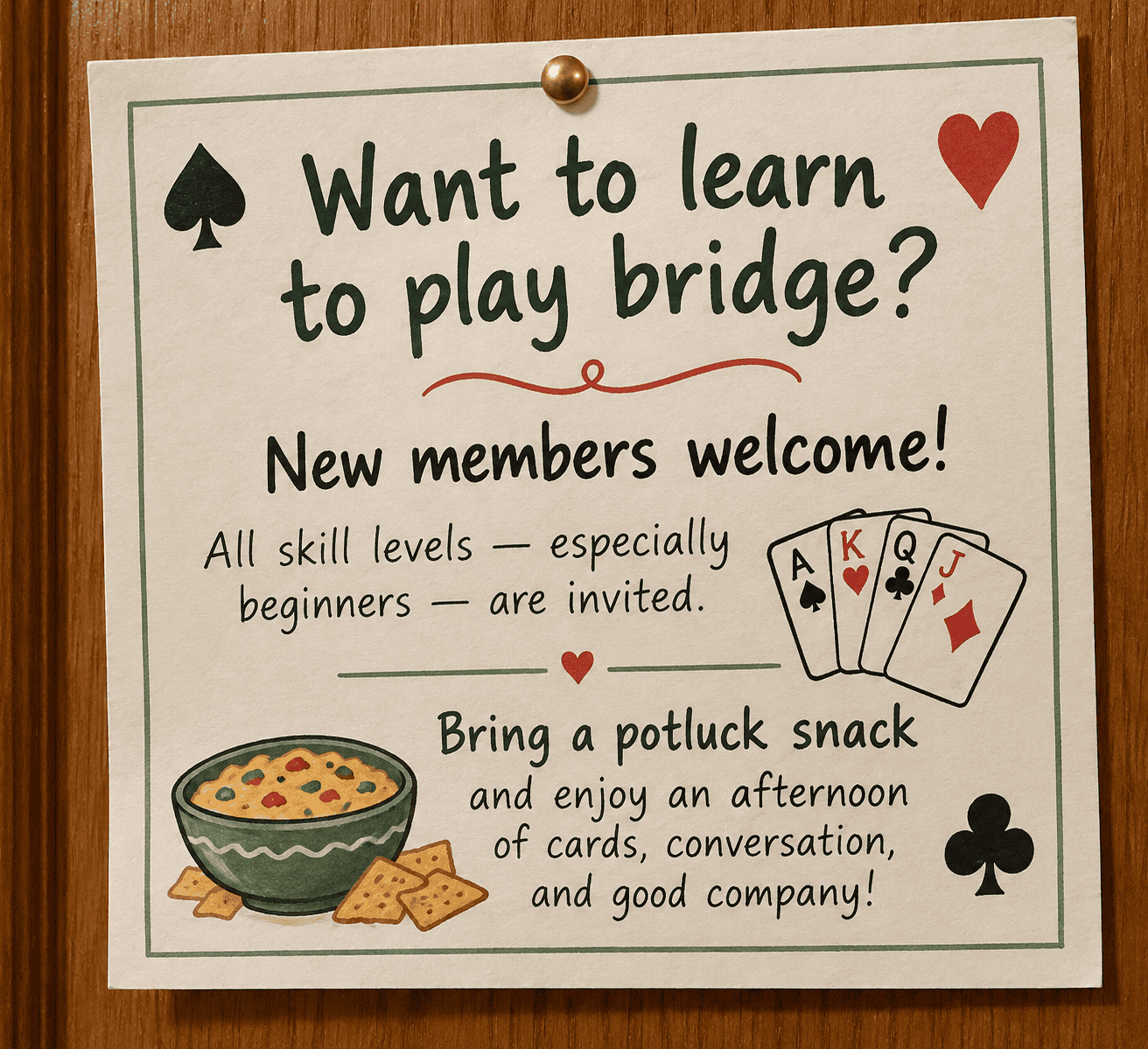
Want to learn to play bridge? New members welcome. Bring a potluck snack.
A tiny sign posted at Sandy Cove community hall made all the difference. That sign said. “Want to learn to play bridge? New members welcome. Bring a potluck snack.”
My extremely shy mother was able to walk through that door.
I’ve come to think the last sentence might have been the most important part.
Bring something.
She didn’t have to arrive worried about looking foolish because she couldn’t play bridge, or being the new kid on the block. But equally important was that she didn’t have to walk in empty-handed to a room full of strangers and somehow manufacture an introduction.
She already had the necessary social lubricant (no, not alcohol…dip). It was all the armour she needed to walk into that setting all alone. Courage can come in many forms; sometimes it’s cheese dip.
She could walk in carrying a plate of snacks or a bowl of something and ask where she should put it.
Someone could ask what she’d brought.
She could ask who made the devilled eggs.
She didn’t have to explain herself: Hello, I’m Carole, and I recently moved here and would very much like some friends.
The bridge club existed. That’s one thing.
It explicitly welcomed beginners. That’s another.
“Bring a potluck snack,: was like a weird little safety net, or a prop for a shy person. It helped with social facilitation. My mother could never muster the force of personality that some people had, but she did have cheese dip.
One thing I’m frequently asked is: how do older adults make friends? I could give you a list of the things that I’ve done. And that might actually help some of you. But if you’re like my mother, my personal approach might not really resonate with you. But Carole’s might.
Finding your own new tribe in a new community isn’t always easy. Making new friends can definitely involve a certain amount of uncertainty and risk. Perhaps a way around those uncomfortable facts is to look for outside-the-box opportunities and maybe a bit of unconventional armour that serves you best.
Related Reading
If you enjoy following ordinary observations that turn into bigger questions, you might also like:
- I Don’t Go to the Farmer’s Market for the Strawberries – Why ordinary places may be an amazing third space for making friends in retirement
- Pappy, Participation, and a Retirement Toast
- The Pygmalion Effect and the New Reality of Retirement Expectations
- Retirement and Social Connection: The Danger of “Bowling Alone”
Research Note
The observations in this article are informed by ongoing reading and research in psychology, sociology, adult development, aging, friendship, purpose, identity, and life transitions. While these essays are observational rather than academic, many of the underlying ideas are grounded in established research.
- Social Interactions and Well-Being: The Surprising Power of Weak Ties — Sandstrom & Dunn (2014)
- The researchers found that interactions with acquaintances, not just close friends, were associated with greater happiness and feelings of belonging. It’s relevant to how small social encounters can contribute to building connections, a sense of belonging, and emotional well-being.
- Social Relationships and Mortality Risk: A Meta-analytic Review — Holt-Lunstad, Smith & Layton (2010)
A major review of 148 studies examining associations between social relationships and survival. It provides broader context for why social connection, meaningful relationships, and loneliness and isolation matter.

Cynthia Ross Tustin is the founder of I'm Thinking of Retiring, an online publication exploring the psychology, purpose, and everyday realities of life after work. A retired Fire Chief, former ICU and Emergency Room nurse, instructor, and policy writer, she combines lived experience, research, and a lifelong curiosity about human behaviour to write thoughtful essays on retirement, identity, purpose, friendship, and the ordinary moments that quietly reveal something larger. Through her Retirement Field Notes and Ordinary Tuesday series, she encourages readers to approach this next chapter with curiosity rather than certainty.