Working draft title
Retirement Hobbies – Are You Sure That’s What You Want?
Retirement Field Notes: Observations from the Trenches
Depending on who you’re listening to, or maybe just in general, society’s primary response to a family member’s or a colleague’s retirement is “get a hobby.” I’ll tell you up front, I think it might be more of a communication strategy or a marketing plan to solve a work problem.
Take up a hobby. Find something to fill your time. Stay occupied. Keep yourself active. It must be true; it’s on all the greeting cards!
I’ve heard variations of these suggestions so often that I rarely think about them twice. People mean well when they say them. But the advice has become so clichéd that, to me, it’s started to feel a little like “sorry for your loss.”
And yes, I said work problem, not a retirement problem. Hear me out.
And perhaps “take up a hobby” is sometimes uttered for much the same reason. We’re uncomfortable, we’re not quite sure what else to say, and we reach for something familiar. So, if “get a new hobby” was a communication strategy, it was kinda lame, and a bit lazy. But it filled a need.
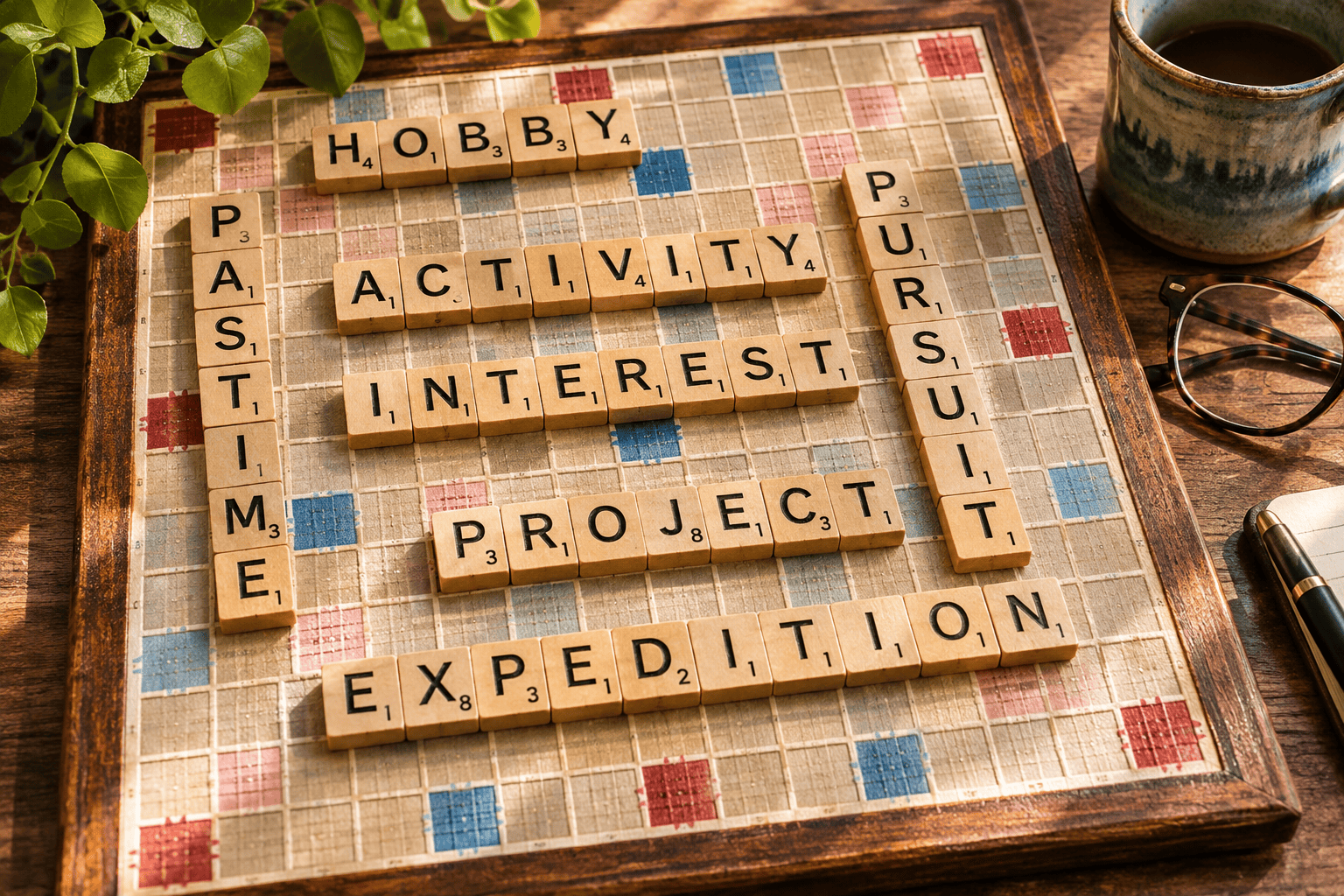
As a marketing plan, well, you can slap the words “retirement hobbies”, “retirement activities,” or even pastimes to fill a retiree’s day on virtually everything. From cliched greeting cards to golf passes to retirement communities.
Good Intentions
Yes, the intentions are generally good. But the suggestion often comes from someone who is still working and assumes that those of us who aren’t must have an extraordinary amount of time on our hands. And perhaps that’s the real root of it all: work is an all-consuming endeavour in the average person’s life. And while you’re still working, you’re unable to truly fathom life without it.
Our “careers” are doing a tremendous amount of life’s load-bearing. And I don’t just mean financially. Our jobs, whether we love them or hate them, give us a place to go, purpose, at-hand relationships with friends, and a place where our skills are both useful and needed. That’s a mountain of life’s scaffolding disguised as “work.”
So, for those who are still working, retirement really might be seen as the “absence” of something that must be filled. For those of us who have been retired for more than a minute, it looks like a space we might want to use for ourselves.
In fairness, this is just the gospel according to Cynthia, not anything found in science. It’s also not in any greeting cards, on any retirement cakes, or stuffed into any glossary sales brochure for activities for your second act. Just me… spitballing.
Communication strategy or marketing plan sounds a bit jaded, doesn’t it?
Now look at the language we use when people are retiring
Keep yourself busy.
Find something to fill your time.
Take up a hobby.
Stay occupied.
Here’s the part worth getting a bit uncomfortable. If we’re using this language, aren’t we inadvertently telling people that they have (or are about to have) a post-work problem – a hobby deficiency. Who wants to be tossed that hot potato at the end of a forty-year career?! Post-work problem is a Cindy-ism, an empirical definition.
The problem, since I’m the one spitballing here, is on the work side. That’s the side that made “the job” the sole supplier of usefulness, structure, and friendship — and what that says is something about how work is organised, not about how retirees spend Tuesday. Framing it as a hobby problem means the person carries the fix alone, and quietly fails if they don’t find the right one. That’s more scaffolding than a word like hobby, activity, or pastime is meant to carry.
Perhaps there’s a more optimistic approach?
So no, I’m not totally jaded. Just mildly disappointed with the narrow scope of language that we keep assigning to our second adulthood. Hobby was fine when the concept of retiring at 65 was introduced in 1935 (Social Security Act of 1935). The majority of people generally lived much shorter lives back then.
Just FYI, here’s the link that supports that: Life expectancy: what does this actually mean? How is life expectancy calculated, and what does it mean? What’s the difference between period and cohort life expectancy?
Most of us have some personal family anecdotal evidence to back this up. My maternal grandfather lived approximately seven years when he retired from the railroad in the 1960s. My paternal grandfather was the outlier from back then. He lived another 45 years when he retired from the meatpacking plant.
My dad lived an additional thirty years after retiring. My long-winded point is that is a spacious amount of time to have, and that makes the concept of “get a hobby” sound inadequate, or perhaps “underwhelming.”
Sir Ken Robinson may offer better, more optimistic words. In his second book, Finding Your Element (2013), his advice is to explore what happens when what you’re good at meets what you love doing, and the book invites readers of any age to consider that question.
And my interpretation of his suggestion is that you can carry a skill you love from work into retirement. That seems infinitely more appealing to me than starting from scratch to fill your day.
Carry a skill you love from work into retirement
When I was working, I loved the researching and writing portion of my job. The difference now is that I can write for who I want, when I want. I loved it and wanted more. So I retired early from the fire service. My pension allows me to treat writing as a second career. That opportunity exists because the pension means that I can afford to be a rookie again.
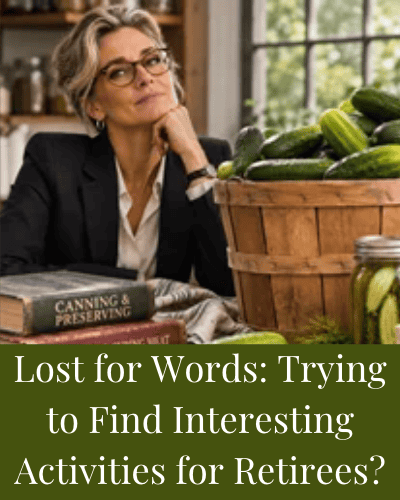
I recently had a great chat with a retired forensic accountant. Her family thought her new hobby should be making and preserving fruits and vegetables. They even gave her a bushel basket of cucumbers to seal the deal. She was not amused. What she really wanted was to volunteer for a charitable position on a local hospice board. So she treated their suggested “hobby” more as a favour to her daughter; she’d use her accounting expertise benefiting charities, not catching criminals.
A different approach
My dad, well, he went way up to northern Ontario and helped at a newly emerging gold mine that our neighbour owned. Not to dig or pan for gold, but to help with all the mandatory government paperwork. He was a wiz at it, and it provided him with something to do out in the fresh air with a bunch of his buddies. In hindsight, I’d probably say that dad used his newfound activity more like a nicotine patch; to wean himself off work and into a slower pace.
And my grandfather, the one from the meat-packing plant? Well, he was a plumber and a steam fitter. And when he retired, what did he do? Well, for 45 years, Pappy actually did fill his days with hobbies and interests. He played golf three times a week, read a book a day, and filled the gaps with fishing, billiards, shuffleboard, and poker.
But no one actually suggested he needed a retirement pastime. He did that stuff constantly before he retired. So that grandfather wasn’t so much about carrying what you love forward in a new way. He was just more of a ” continue with your passions until you die kinda guy. Without exception, he was the most normal, grounded person I’ve ever met.
So let me land the plane here.
I began this particular essay theorizing that perhaps the “still working portion” of society uses an oversimplified set of words to talk about post-work life. The extra jaded part of me, down deep where disdain and my love of sarcasm live, believes that it’s easier to sell somebody a solution when you’ve supplied the problem.
But thankfully I am my grandfather’s daughter, plus I do love a good Sir Ken Robinson book. That means that I will almost always lean toward common sense and optimism. Let’s stop telling people (assuming) that they need a new hobby and to find new activities. When retirement comes, focus on what you already love and enjoy, tweak it for the new “space,” and do that first.
Related Reading
If you enjoy following ordinary observations that turn into bigger questions, you might also like:
Research Note
The observations in this article are informed by ongoing reading and research in psychology, sociology, adult development, aging, friendship, purpose, identity, and life transitions. While these essays are observational rather than academic, many of the underlying ideas are grounded in established research.
Jahoda, M. (1982). Employment and unemployment: A social-psychological analysis. Cambridge University Press.
Jahoda describes what paid work can give us alongside a paycheque. It structures the day, brings us into regular contact with other people, and gives us a chance to contribute to something larger than ourselves. Her work on employment and unemployment helps explain how much a job can carry in an ordinary week. Read a scholarly overview of Jahoda’s framework.
Atchley, R. C. (1989). A continuity theory of normal aging. The Gerontologist, 29(2), 183–190.
Atchley proposes that people often adapt to change by drawing on skills, interests, routines, and relationships they already have. That can mean doing more of what you’ve always enjoyed, as Pappy did, or using a familiar skill in a setting you choose. Read the article abstract.
Wang, M., Henkens, K., & van Solinge, H. (2011). Retirement adjustment: A review of theoretical and empirical advancements. American Psychologist, 66(3), 204–213.
The authors review what shapes the transition into retirement and propose that adjustment depends partly on the resources people have and how those resources change. A pension, for instance, gave me the financial room to take a skill I already had and be a rookie again in a second career. Read the review abstract.
Cynthia Ross Tustin is the founder of I'm Thinking of Retiring, an online publication exploring the psychology, purpose, and everyday realities of life after work. A retired Fire Chief, former ICU and Emergency Room nurse, instructor, and policy writer, she combines lived experience, research, and a lifelong curiosity about human behaviour to write thoughtful essays on retirement, identity, purpose, friendship, and the ordinary moments that quietly reveal something larger. Through her Retirement Field Notes and Ordinary Tuesday series, she encourages readers to approach this next chapter with curiosity rather than certainty.